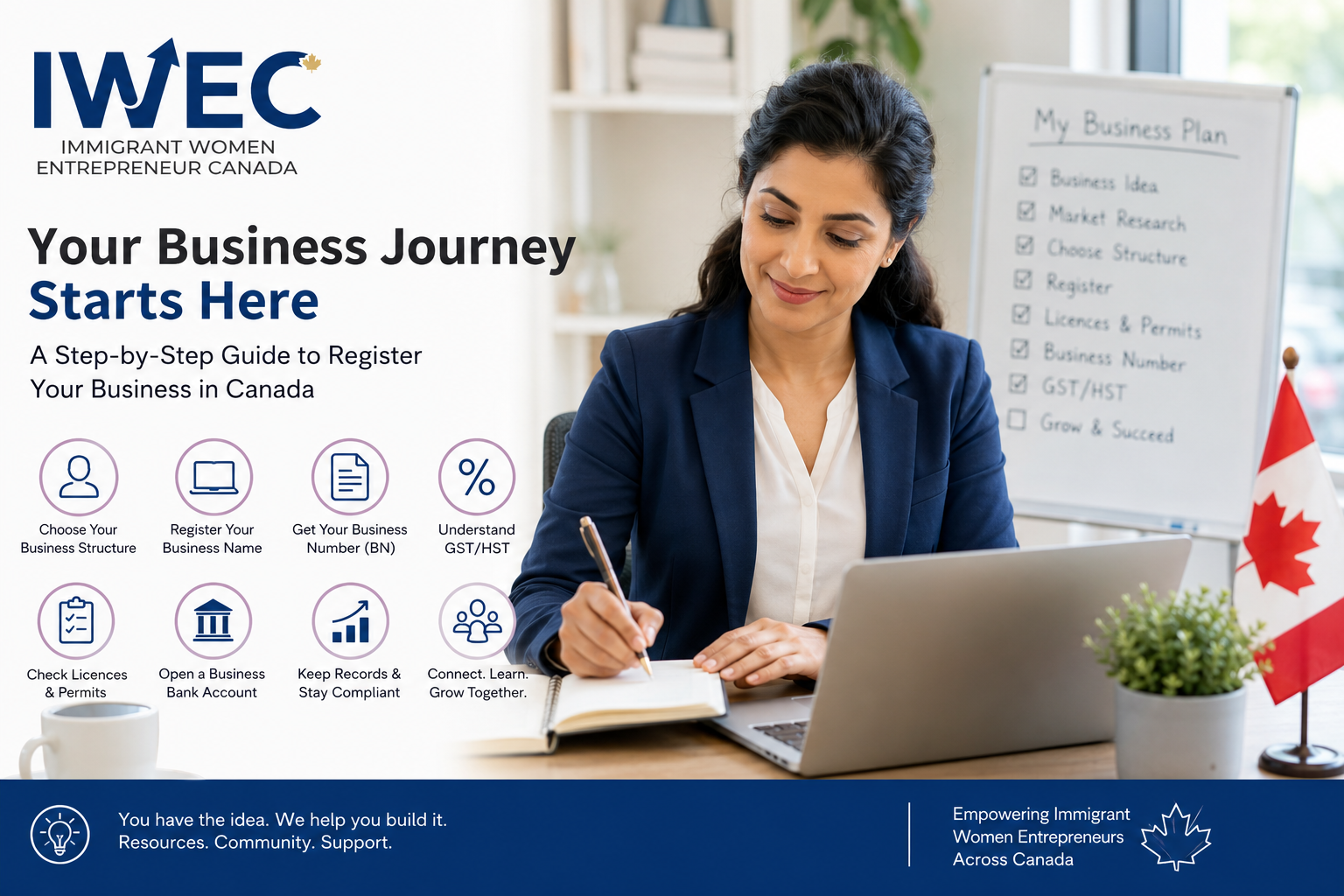
For many immigrant women entrepreneurs, starting a business in Canada is a game of prosperity and risk worth taking. Your idea is becoming something more formal, visible, and ready to grow, but Canada has federal, provincial, territorial, and municipal rules.
If you are trying to register a business in Canada, then you need to be clear with terms like sole proprietorship, corporation, business number, GST/HST, permits, and payroll accounts before you even make your first sale.
This guide breaks the process into clear steps so you can move forward with more confidence.
Before You Register: Know What You Are Building
Before you register a business in Canada, take time to clarify the basics. The Government of Canada recommends knowing where your main office will be located, which provinces or territories you plan to operate in, your proposed business name, and the business type that fits your needs.
Start with these questions:
- What product or service will I offer?
- Will I operate online, locally, or across provinces?
- Will I work alone or with partners?
- Do I plan to hire employees soon?
- Is there any legal or financial risk in my work?
- Do I want to grow slowly or build a larger company?
Your answers will help you choose the right structure and registration path.
Step 1: Check Your Immigration or Work Conditions
If you are a permanent resident or Canadian citizen, you can generally start and own a business in Canada. If you are in Canada on a temporary status, such as a work permit or study permit, review your conditions before you start business activity.
IRCC says some work permit conditions may include the type of work you can do, the employer you can work for, where you can work, and how long you can work.
This does not mean you cannot build a business idea. It means you should confirm what you are allowed to do before taking paid work, signing contracts, or operating publicly.
Step 2: Choose Your Business Structure
Most small businesses begin with one of three common structures.
Sole Proprietorship
This is often the simplest structure for one person starting a small business. You and the business are legally connected, which makes it easier to start but also means you carry personal responsibility for the business.
Partnership
A partnership may work if two or more people are starting the business together. A written partnership agreement is strongly recommended, even if the partners are friends or family.
Corporation
A corporation is a separate legal entity. It can offer stronger legal separation and may be useful if you plan to grow, raise funding, hire staff, or manage higher risk. It also requires more paperwork and ongoing filings.
There is no single best option. The right choice depends on risk, taxes, cost, ownership, and growth plans. When unsure, speak with an accountant or lawyer before registering.
Step 3: Choose and Check Your Business Name
Your business name matters for branding, trust, and registration.
If you are a sole proprietor operating only under your exact legal name, you generally do not need to register the business name. In most other cases, you need to register your legal corporate name or trade name. Trade names are registered through the province or territory where you plan to do business.
Before you choose a name:
- Search online for similar businesses.
- Check your provincial or territorial registry.
- Check domain and social media availability.
- Avoid names that sound too similar to existing brands.
- Consider trademark protection if the brand may grow across Canada.
A good name should be clear, easy to remember, and flexible enough for future growth.
Step 4: Register With the Right Government Registry
Registration depends on your business structure and where you operate.
If you are registering a sole proprietorship or partnership, you usually register through your province or territory. If you incorporate, you may choose federal incorporation or provincial/territorial incorporation.
Federal incorporation can give a corporation broader name protection across Canada, while provincial or territorial incorporation gives name rights in that jurisdiction.
Keep copies of your registration documents. You may need them for banking, taxes, funding, leases, contracts, or supplier accounts.
Step 5: Get a CRA Business Number and Program Accounts
A Business Number, often called a BN, is a unique number used by the Canada Revenue Agency to identify your business.
CRA Business Registration Online is the fastest and easiest way to get a BN and certain CRA program accounts, such as GST/HST, payroll, and corporation income tax accounts.
You may need CRA program accounts if you:
- Collect GST/HST
- Hire employees
- Incorporate
- Import or export
- Need payroll deductions
- File corporation income tax
If you already have a BN, you may not need a new one. CRA advises using your existing BN to register any additional program accounts you need.
Step 6: Understand GST/HST Registration in Canada
GST/HST rules are important for small businesses.
For most businesses, if you do not exceed the $30,000 small supplier threshold over four consecutive calendar quarters, you usually do not have to register for GST/HST.
You may choose to register voluntarily if you make taxable sales in Canada, i.e., you exceed the $30,000 threshold; you usually must register for GST/HST and start charging it based on CRA timing rules.
This can be beneficial in some cases, but it also brings filing responsibilities. Speak with a tax professional if you are unsure.
Step 7: Check Permits and Licences
Registration does not always mean you are fully ready to operate.
Some businesses need permits or licences from federal, provincial, territorial, or municipal governments. Canada.ca lists BizPaL as a tool for finding federal, provincial, territorial, and municipal business permits and licences in Canada.
BizPaL is free and helps business owners search for permits and licences based on business type and location.
This step is especially important for food, beauty, childcare, health, transportation, import/export, construction, and home-based businesses.
Step 8: Set Up Banking, Records, and Bookkeeping
Once registered, open a separate business bank account if possible. This keeps your personal and business money clearer.
Start tracking:
- Sales
- Invoices
- Receipts
- Expenses
- Taxes collected
- Mileage, if relevant
- Contracts and supplier payments
Good records help you file taxes, apply for funding, track growth, and make better decisions.
Build With Support, Not Confusion
Registering a business in Canada is more than paperwork. It is a foundation for trust, clarity, and growth.
Start with your business details. Choose your structure. Check your name. Register in the right place. Understand CRA accounts, GST/HST, permits, and records.
You do not need to know everything before you begin.
You need the right information, the right support, and the confidence to take the next step.
Final Thoughts
As an immigrant woman entrepreneur, you may be learning a new system while building confidence, customers, and community. You do not have to do it alone.
Use beginner business resources, ask questions, speak with professionals when needed, and connect with other women who understand the journey.
IWEC supports immigrant women entrepreneurs with community, learning, mentorship, and practical business resources. Use IWEC beginner business resources to take your next step with more clarity and confidence.