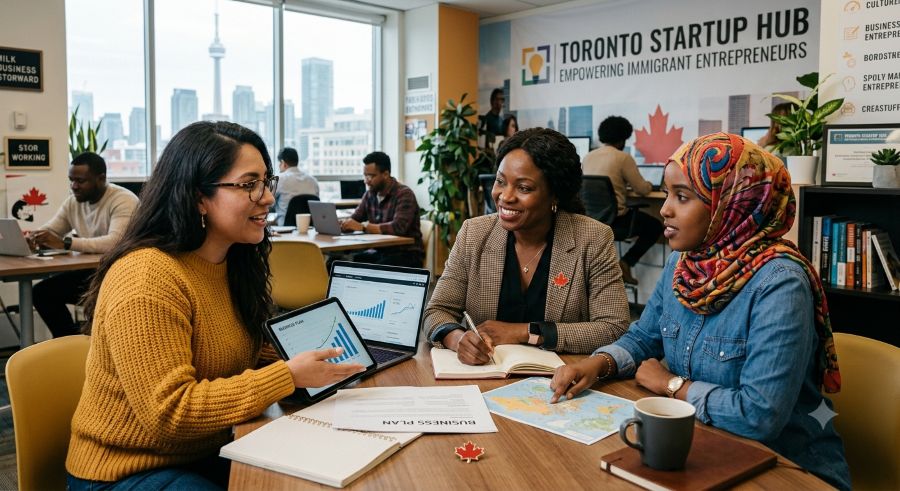
Starting a business is hard. Starting one in a new country, with no Canadian credit history, unfamiliar rules, and a network that is still taking shape, can feel like starting from zero. Many immigrant women entrepreneurs in Canada are doing exactly that, often while managing family and settlement at the same time. This guide explains what immigrant women business owners in Canada face, where support is available, and how a business can grow step by step.
What Challenges Do Immigrant Women Entrepreneurs Face?
The biggest challenges are limited credit and capital, a thin local network, unfamiliar regulations and market expectations, and the pressure of balancing family and business.
| Challenge | What it looks like | What helps |
| Credit and funding | No Canadian credit history, so lenders see higher risk | Newcomer-focused loans, building business credit |
| Network | No local contacts or referrals | Communities, networking events |
| Regulations | Unsure about registration, tax and licences | Registration guides, local business advisors |
| Market knowledge | Pricing, customer expectations and culture differ | Mentorship, local market research |
| Confidence and time | Juggling family and business | Peer support, mentors |
Research on newcomer credit found that traditional credit models often classify newcomers as high risk, and that lending options can differ from one bank branch to another.
These challenges also compound one another. Without credit history, funding is harder. Without a network, it is harder to find the customers whose revenue builds that credit. Naming the barrier clearly is the first step to choosing the right support.
Your Cultural Background Can Be a Business Advantage
Challenges are only half the picture. Many immigrant women bring strengths that local competitors can't easily copy:
- Language skills that open up customers who are underserved in their own language.
- Insight into community needs, such as products and services others overlook.
- Cross-border contacts that help with sourcing, partnerships, and trade.
- Professional experience from a previous career that can become a consulting, training, or service business.
- Community trust, which often turns into early referrals and repeat customers.
Put these strengths in your business story, your website, and your pitch. They are what make your business stand out from the ordinary.
Where Can Immigrant Women in Business Find Support?
Support comes from four places: community networks, mentorship, funding programs, and local business advisory services.
- Communities and networks: Women's and newcomer entrepreneur groups offer referrals, peer advice, and visibility, both online and in person.
- Mentorship: An experienced founder can explain pricing, customers, and local rules in plain terms, and can introduce you to useful contacts.
- Funding: Futurpreneur offers startup loans for younger newcomers with limited or no Canadian credit history. WEOC's national loan program for women has no minimum credit score requirement. Eligibility differs by program, and some require Canadian citizenship or permanent residency, so check each official page before applying.
- Local advisory and training: Settlement agencies and provincial small business centres run free or low-cost workshops and one-to-one advice sessions.
How Can Newcomer Women Entrepreneurs in Canada Grow?
Growth works best in steps rather than all at once. These six levers help most:
- Build a local network deliberately. Attend one event or meetup a month, and follow up with everyone you meet.
- Build visibility. Set up a Google Business Profile, list your business in relevant directories, and ask happy customers for reviews and referrals.
- Use mentorship to shortcut mistakes. A mentor who has made the same mistakes can save you months of trial and error.
- Build business credit. Use a business credit card responsibly and pay on time, so lenders see a Canadian track record.
Common Mistakes Immigrant Women Entrepreneurs Make
Most early mistakes are avoidable once you know them. These five come up most often:
| Mistake | Why it hurts | Better move |
| Undercharging | Low prices attract the wrong customers and shrink profit | Research local rates and price for value |
| Skipping registration or tax setup | Limits banking, funding, and credibility | Register early and learn your tax obligations |
| Relying on one community for a network | Referrals stay within one circle | Add one mainstream group alongside your own community |
| Mixing personal and business money | Makes tax time hard and slows credit building | Open a separate business account |
| Waiting until everything is perfect | Delays your first customers and feedback | Launch small, then improve |
Pricing is the most common trap. For a deeper look, read Stop Undercharging: How to Price Your Business Services in Canada.
Grow With Support as an Immigrant Entrepreneur in Canada
Immigrant entrepreneurs in Canada face real barriers, from credit gaps to a missing network, but they are not facing them alone. Support exists in communities, mentorship, funding programs, and local advisory services, and growth tends to come from steady, practical steps rather than one big leap.
Start with the foundation, build relationships deliberately, and ask for guidance early. Communities such as the Immigrant Women Entrepreneur Canada (IWEC) network offer a free place to meet peers and mentors, which can make those first steps feel far less lonely. If you are unsure where to begin, pick one action this month: register your business, book a mentor conversation, or attend one networking event.
FAQs
Q1. Can immigrant women start a business in Canada?
Yes, in most cases. Permanent residents and open work permit holders can start a business. Closed work permit holders generally cannot run their own, and students must follow their permit rules. Check your permit conditions first.
Q2. Are there grants or loans for immigrant women entrepreneurs?
Grants aimed only at immigrant women are limited, but loans and programs exist for newcomers and for women business owners. Compare eligibility, loan terms, and credit requirements on official program pages before you apply.
Q3. Do I need a Canadian credit history to get business financing?
Not always. Some newcomer and women-focused programs accept little or no Canadian credit history. Traditional lenders may still ask for it, so building business credit early, such as with a responsibly used business credit card, helps.
Q4. How do I find a mentor as an immigrant woman entrepreneur?
Start with immigrant women's business communities, settlement agencies, and women's enterprise organizations. Many offer mentor matching. Define your goal first, such as pricing or funding, so the match fits your needs.
Q5. What is the first step to starting a business as a newcomer?
Confirm that your immigration status allows you to run a business, then choose a business structure, such as a sole proprietorship or corporation, and register it in your province. Open a business bank account next.